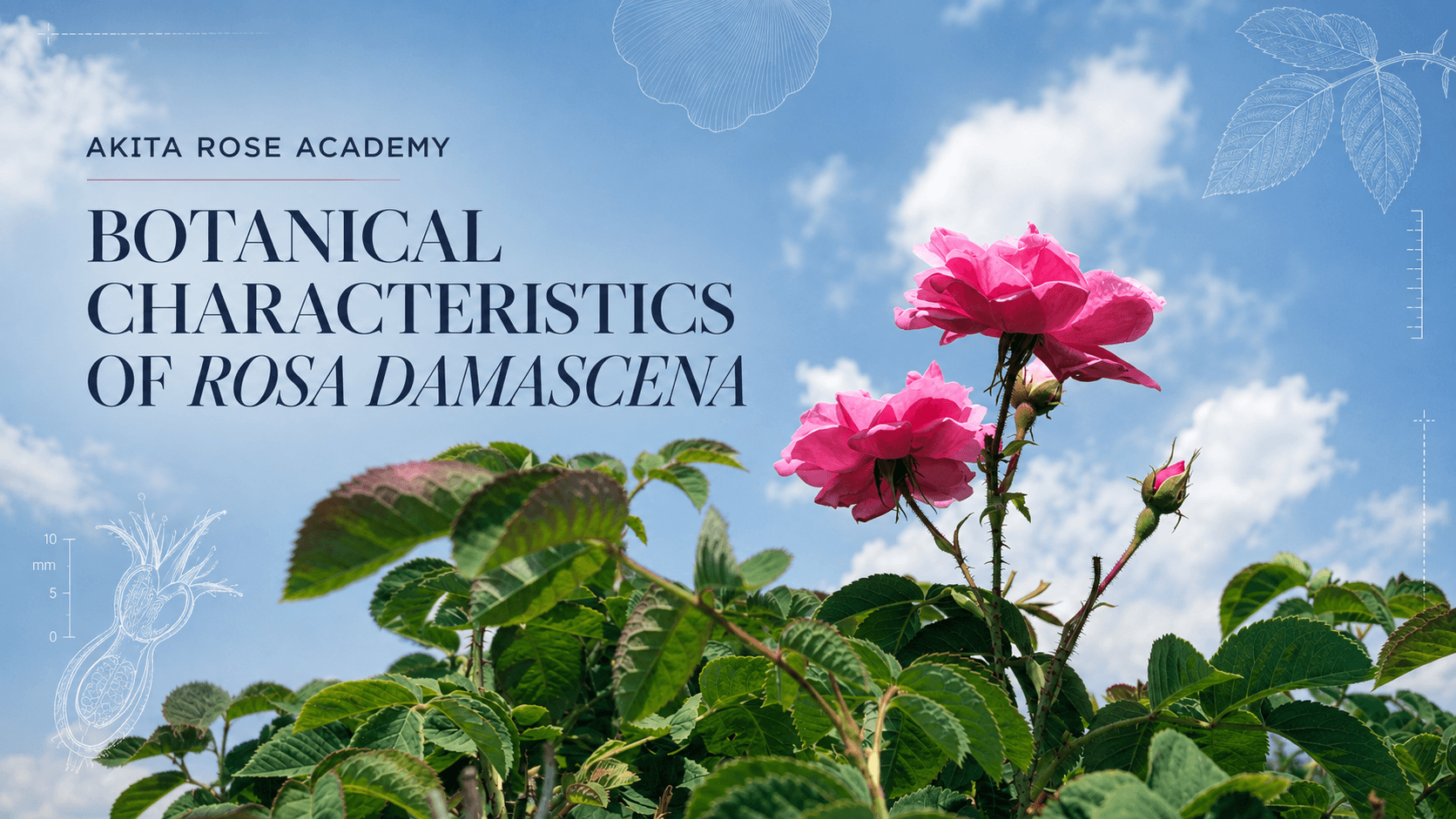
Rosa damascena is more than a beautifully scented rose. It is a valuable oil-bearing plant with a distinctive botanical structure and complex reproductive characteristics. The flowers cultivated in Isparta, Türkiye, are used to produce rose distillate, rose water, rose oil, rose concrete, and rose absolute.
Understanding a rose’s botanical characteristics involves more than learning what the plant looks like. Leaf arrangement, flower anatomy, pollination, fruit development, and propagation methods all help identify the plant correctly and clarify the botanical origin of the products derived from it.
In this chapter, we take a closer look at Rosa damascena, from its roots and branches to its flowers, fruits, and seeds.
Scientific Classification of Rosa damascena
The Isparta Rose belongs to the Rosaceae family and the genus Rosa.
| Classification level | Scientific classification |
|---|---|
| Kingdom | Plantae |
| Major group | Angiosperms |
| Order | Rosales |
| Family | Rosaceae |
| Genus | Rosa |
| Accepted taxon in some current databases | Rosa × damascena Herrm. |
| Commonly used scientific name | Rosa damascena Mill. |
| Common English names | Damask rose, oil-bearing rose, pink oil rose |
| Common Turkish names | Isparta Gülü, yağ gülü, Şam gülü, pembe yağ gülü |
Why Do We See Two Different Scientific Names?
In scientific, agricultural, and commercial sources, this rose is commonly identified as Rosa damascena Mill. Some modern botanical databases use the name Rosa × damascena Herrm. to indicate its hybrid origin. In botanical nomenclature, the “×” symbol shows that a plant is considered a hybrid.
The Plants of the World Online database of the Royal Botanic Gardens, Kew, accepts the name Rosa × damascena Herrm. and describes it as a hybrid developed in cultivation.
Cosmetic ingredient lists follow a different naming system. Names such as Rosa Damascena Flower Distillate and Rosa Damascena Flower Oil are INCI names. INCI is the internationally recognized system used to identify cosmetic ingredients.
Rose Academy Note
Rosa damascena, Rosa × damascena, and “Rosa Damascena” on a cosmetic label may all appear in different contexts. Botanical names are written in italics, while INCI names follow the standardized format used on cosmetic labels.
A Complex Hybrid Origin
The precise botanical origin of Rosa damascena has been explained differently across scientific sources.
Kew’s current taxonomic database presents it as a hybrid associated with Rosa gallica and Rosa moschata. However, a molecular study by Iwata, Kato, and Ohno suggested a more complex, triparental origin for the old Damask rose groups they examined. The study identified Rosa gallica, Rosa moschata, and Rosa fedschenkoana as possible ancestral species.
These explanations do not necessarily invalidate one another. Different cultivated groups and varieties may have developed under the broad name “Damask rose” over long periods. In addition, taxonomic classification and genetic analysis of particular cultivated specimens do not always address botanical origin in exactly the same way.
It is therefore more accurate to describe Rosa damascena as a rose with a long and complex history of cultivation and hybridization rather than reducing its origin to one simple cross.
General Structure of the Plant
Rosa damascena is a perennial, woody shrub. Being perennial means that, under suitable conditions, it can live for many years, producing new shoots from the same established root system.
The plant develops numerous branches from close to ground level. With regular care and pruning, it may form a dense, hedge-like structure.
Its principal botanical parts include:
- Root system
- Root crown
- Perennial woody canes
- Young annual shoots
- Buds
- Leaves
- Flowering shoots
- Flowers
- Fruits that may develop after successful fertilization
Root System
The oil-bearing rose can develop a strong root system that extends deeply into suitable soil.
The roots perform several essential functions:
- Anchoring the plant in the soil
- Absorbing water and minerals
- Supporting plant growth
- Storing certain nutrients
Very heavy soil, poor drainage, or a high water table may negatively affect root health. Oil-bearing roses generally grow better in deep, aerated, well-drained soils.
Stems, Canes, and Young Shoots
The long-lived woody canes form the main framework of the shrub. New leaves and shoots can develop from buds located along these canes.
Young shoots grow during the season, and under suitable conditions some of their buds develop into flowering shoots. Flower formation depends not only on the plant’s genetics but also on:
- The condition of previously developed canes
- Pruning practices
- Temperature
- Light exposure
- Water availability
- Soil nutrition
A publication from Türkiye’s Western Mediterranean Agricultural Research Institute reports that a flowering stem may carry an average of five to ten flower buds. Because these buds do not all develop simultaneously, every flower in a rose field does not open on the same day.
Did You Know?
The gradual opening of flowers is one of the main reasons why the rose harvest must be repeated every morning for several weeks.
How Do Buds Become Flowers?
Not every bud on the plant develops into a flower. Some buds produce vegetative shoots that form leaves and branches. Others, under suitable developmental and environmental conditions, become flower buds.
This distinction allows the plant to distribute its resources between growth and reproduction:
- Vegetative growth: Formation of roots, stems, branches, and leaves
- Reproductive growth: Formation of flowers, fruits, and seeds
The timing and method of pruning are therefore important. Excessive pruning or the removal of potential flowering shoots at the wrong time may reduce the number of flowers produced during the following harvest.
Flower Characteristics
The flowers of the oil-bearing rose cultivated in Isparta are generally:
- Pink
- Semi-double
- Strongly and characteristically scented
- Composed of numerous petals
- Delicate in structure
“Semi-double” means that the flower has more than the single row of five petals found in many wild roses, but it is not as densely packed with petals as some ornamental garden roses.
Reported flower diameter and weight can vary. Baydar described a fresh oil-bearing rose flower as having an average diameter of approximately 7.5 centimetres and an average weight of 2.5 grams. A Turkish Ministry of Agriculture publication reports flowers approximately 5–6 centimetres in diameter, weighing 2–4 grams, with an average of 28–33 petals.
These differences should not automatically be interpreted as contradictions. Flower measurements can vary according to:
- Cultivar or cultivated clone
- Elevation of the field
- Soil and climatic conditions
- Stage of the flowering season
- Degree of flower opening
- Sampling and measurement method
Botanical Close-Up
Flower diameter or petal count alone cannot confirm that a rose is Rosa damascena. Reliable identification requires an evaluation of the plant’s complete morphology and, when necessary, genetic evidence.
Understanding the Anatomy of a Rose Flower
1. Petals
The petals are the thin, pink, fragrant parts of the flower. Their colour and scent help attract pollinating insects.
Isparta oil-bearing roses may have approximately 28–33 petals. According to the Turkish Ministry of Agriculture publication, petals may represent approximately 70–75% of the flower’s total weight.
2. Sepals
Sepals are the usually green structures that surround and protect the developing flower bud. The oil-bearing rose flower generally has five sepals.
3. Hypanthium
The hypanthium is the cup-shaped structure at the base of the flower. The petals, sepals, stamens, and pistils are arranged around or within this area.
Following fertilization, the hypanthium may enlarge and become fleshy, eventually forming the outer structure commonly recognized as a rose hip.
4. Pedicel
The pedicel is the slender stalk connecting the flower to the flowering stem. It contains vascular tissues that transport water and nutrients to the flower.
5. Stamens
The stamens are the male reproductive structures that produce pollen. Each typically consists of an anther, where pollen is produced, and a filament that supports it.
According to the average value reported by Baydar, an oil-bearing rose flower may contain approximately 90 stamens. The number can vary among individual flowers.
6. Pistils
The pistils are the female reproductive structures of the flower. They include the stigma, which receives pollen; the style, through which the pollen tube grows; and the ovary, which contains the ovules.
Baydar’s morphological assessment reported approximately 40 stigma-and-style structures per flower. This should be understood as an average rather than an unchanging number.
Where Is the Volatile Oil Found?
A significant proportion of the volatile compounds responsible for rose fragrance is associated with the surface tissues of the petals. Fragrant molecules may be synthesized and released from cells in the petals’ outer layer, known as the epidermis.
However, it would be inaccurate to state that the volatile oil is found only in the petals.
The Turkish Ministry of Agriculture publication associates approximately 70–75% of the total volatile oil with the petals, with the remainder linked to other floral organs. These proportions may vary depending on growing, harvesting, and analytical conditions.
Sepals, the hypanthium, and other flower structures may also contribute to the quantity and composition of the resulting oil. For this reason, rose distillation generally uses the whole flower collected beneath the base rather than only detached petals.
Leaf Structure
The leaves of Rosa damascena are compound rather than simple. This means that a single leaf consists of several smaller leaflets attached to a shared stalk.
General leaf characteristics include:
- Usually three, five, or seven leaflets
- A single terminal leaflet at the tip
- Other leaflets arranged opposite or nearly opposite one another
- Serrated leaflet margins
- Usually dark-green colour
- A slightly waxy or matte surface, depending on the cultivar and developmental stage
The leaves carry out photosynthesis, converting sunlight into chemical energy that the plant can use. This energy supports the development of new roots, shoots, leaves, and flowers.
Did You Know?
The small green sections visible on a rose leaf are not separate leaves. They are leaflets that together form one compound leaf.
Are Rose “Thorns” Really Thorns?
The sharp structures on rose stems are commonly called thorns. Botanically, however, they are more accurately described as prickles.
True thorns and rose prickles have different botanical origins.
| Characteristic | True thorn or spine | Rose prickle |
|---|---|---|
| Botanical origin | May develop from a modified branch, leaf, or part of a leaf | Develops from tissues near the outer surface of the stem |
| Internal structure | May be connected to deeper vascular tissues | Generally superficial |
| Removal from stem | Usually more difficult to remove | Often breaks away more easily |
| English terminology | Thorn or spine | Prickle |
Prickles may help protect the plant against herbivores and, in some cases, help its long canes gain support among surrounding vegetation.
What Is Pollination?
Pollination is the transfer of pollen from the stamens to the stigma of a flower.
Pollination and fertilization are not the same process:
- Pollen reaches the stigma.
- Under suitable conditions, the pollen grain germinates.
- A pollen tube grows through the female reproductive structure.
- Fertilization may occur if the male reproductive cell reaches an ovule.
- Fruit and seed development may begin after successful fertilization.
Baydar reported that cross-pollination may be significant in oil-bearing roses and that both insects and wind can contribute to pollen transfer. Rose flowers may provide bees with pollen and small amounts of nectar.
Their colourful, fragrant flowers suggest that insect-mediated pollination is particularly important. The contribution of wind can vary according to the plant, field conditions, and surrounding environment.
What Is Cross-Pollination?
Cross-pollination occurs when a flower receives pollen from a flower on another plant rather than from the same individual plant. This process may contribute to increased genetic diversity.
However, pollen reaching the stigma does not guarantee the production of viable seeds. Pollen viability, genetic compatibility, weather conditions, and the developmental stage of the flower can all affect the outcome.
How Does the Fruit Develop?
If a Rosa damascena flower remains on the plant and is successfully pollinated and fertilized, it may eventually develop a rose-hip-like structure.
The young structure is initially green and may become red or dark red as it matures.
In everyday language, the entire structure is called a rose hip or rose fruit. Botanically, it is more complex:
- The fleshy outer portion develops largely from the enlarged hypanthium.
- Numerous small, hard true fruits may be found inside.
- These small, dry fruits are called achenes.
- The true seeds are contained within the achenes.
The red rose hip is therefore a compound structure containing numerous small fruits.
Botanical Close-Up
The hard pieces commonly called “rose seeds” are often technically achenes—small dry fruits, each containing a true seed.
Why Are So Few Rose Hips Seen in Commercial Fields?
Rosa damascena is capable of developing fruits. However, in commercial oil-bearing rose fields, nearly all flowers are collected during the morning harvest. Most flowers therefore do not remain on the plant long enough to complete pollination, fertilization, and fruit development.
Seeing few fruits in a commercial field does not mean that the plant is genetically incapable of producing them.
Fruit and viable seed production may be affected by:
- Early harvesting of flowers
- The plant’s complex hybrid origin
- Chromosome structure
- Pollen viability
- Compatibility between male and female reproductive structures
- Presence of pollinating insects
- Temperature, rainfall, and wind
- Conditions during fruit development
Baydar reported that although oil-bearing roses produce abundant flowers, they develop relatively few fruits and seeds. The Turkish Ministry of Agriculture publication identifies commercial flower harvesting as one of the primary reasons fruit formation remains limited in cultivated fields.
Seed Characteristics
Following successful fertilization, true seeds may develop inside the achenes. In everyday and agricultural usage, however, the hard achenes themselves are also frequently called seeds.
A Turkish Ministry of Agriculture publication gives an average weight of approximately 0.02 grams for the structures described as seeds. Baydar reported that 100 seeds may weigh approximately two grams. These values are broadly consistent.
Rose seeds may be difficult to germinate. Possible reasons include:
- A hard outer structure
- An embryo that may not be fully developed at harvest
- Physiological dormancy
- The need for suitable alternating warm and cold periods
Controlled moisture and temperature treatments, including stratification, may be required to encourage germination. Even then, plants grown from seed may not have exactly the same characteristics as the parent plant because of the rose’s hybrid origin.
Why Are Commercial Oil-Rose Fields Not Established from Seed?
Commercial oil-bearing rose fields in Isparta are generally established through vegetative propagation rather than seed.
Vegetative propagation produces a new plant from a living part of the parent plant, such as a stem or shoot. Traditional methods used in Isparta include propagation through cuttings and forms of layering.
These methods are preferred because:
- Seed germination may be slow and difficult.
- Seed-grown plants may be genetically different from one another.
- Growers want to preserve the characteristics of selected parent plants.
- Uniform plant structure and consistent crop quality are desirable.
- Vegetative propagation is more suitable for commercial cultivation.
Vegetatively propagated plants are genetically close to the selected parent and may be regarded as clones. Nevertheless, soil, climate, cultivation practices, and plant health can still cause differences in growth and yield.
Why Do Botanical Characteristics Matter for Rose Products?
“Rose” describes a very large group of plants. Not every fragrant or pink rose is the Rosa damascena cultivated for oil and distillate production in Isparta.
Correct botanical identification helps:
- Confirm the rose species being used
- Support raw-material traceability
- Distinguish oil-bearing roses from ornamental roses
- Guide appropriate cultivation and processing methods
- Evaluate cosmetic ingredient information
- Identify plant materials accurately in scientific research
If a scientific study does not identify the rose species correctly, it becomes difficult to determine which plant the findings apply to. Likewise, the words “rose water” alone do not establish the botanical species used to produce a product.
Key Botanical Characteristics of Rosa damascena
| Characteristic | Description |
|---|---|
| Plant form | Perennial, woody shrub |
| Root system | Strong and capable of extending deeply in suitable soil |
| Canes and shoots | Perennial woody canes with young annual shoots |
| Leaves | Compound leaves, usually with three, five, or seven serrated leaflets |
| Flower colour | Usually pink |
| Flower form | Semi-double and strongly fragrant |
| Flower diameter | Approximately 5–7.5 cm, depending on source and conditions |
| Flower weight | Approximately 2–4 grams |
| Petals | Approximately 28–33 |
| Sepals | Usually five |
| Stamens | Approximately 90 according to Baydar’s reported average |
| Pistils | Approximately 40 structures according to Baydar’s reported average |
| Sharp stem structures | Botanically classified as prickles |
| Pollination | Primarily insects; wind may also contribute |
| Fruit | Rose-hip-like structure containing numerous small dry fruits |
| Commercial propagation | Primarily vegetative methods such as cuttings |
These figures represent descriptive ranges and averages. They should not be expected to remain identical in every flower or under every cultivation condition.
Akita Rose Academy Note
Understanding the botanical identity of the Isparta-grown Rosa damascena used by Akita Rose Water is the first step in understanding the origin of the product.
A botanical name identifies the plant from which an ingredient originates. However, it does not explain the entire production method, whether the naturally occurring rose oil has been separated, or what the complete formulation contains. These questions must be evaluated together with the manufacturing method, ingredient list, and product analysis results.
Akita uses oil-bearing Rosa damascena flowers cultivated in Isparta. The rose oil naturally present in the distillate is not separated from Akita Rose Water. This approach makes it important to consider both botanical identity and production method when evaluating the product.
What Have We Learned?
In this chapter, we learned that Rosa damascena:
- Is a perennial, woody shrub
- Can develop a strong root system
- Produces pink, semi-double flowers with numerous petals
- Contains volatile compounds in more than just the petals
- Has compound leaves consisting of several leaflets
- Bears prickles rather than true botanical thorns
- Undergoes pollination and fertilization as separate biological processes
- Can develop a rose hip containing numerous small true fruits
- Is generally propagated vegetatively rather than by seed in commercial fields
Correctly identifying Rosa damascena helps us evaluate the botanical origin of rose water, rose distillate, and rose oil more accurately.
Continue Your Rose Academy Journey
In the next chapter, we will explore where the oil-bearing rose grows and which environmental conditions it requires. We will examine how climate, elevation, soil, temperature, rainfall, and morning dew may influence flower development and harvest quality.
Frequently Asked Questions
1. Is Rosa damascena a tree?
No. Rosa damascena is a perennial, woody shrub. Its numerous canes may give it the appearance of a small tree, but botanically it is classified as a shrub.
2. Are the sharp structures on a rose stem true thorns?
They are commonly called thorns, but botanically they are prickles. Prickles develop from tissues near the outer surface of the stem.
3. Can Rosa damascena produce fruit?
Yes. If a flower remains on the plant and successful pollination and fertilization occur, it may form a rose-hip-like structure. Fruit development is limited in commercial fields because the flowers are harvested early.
4. Why is the oil-bearing rose not usually propagated from seed?
Its seeds can be difficult to germinate, and seed-grown plants may not reproduce the parent plant’s characteristics because of the rose’s hybrid origin. Commercial fields therefore favour vegetative methods such as cuttings.
5. Is the volatile oil found only in the pink petals?
No. Although a large proportion is associated with the petals, the sepals, hypanthium, and other floral structures may also contribute to the quantity and composition of the oil.
References
Baydar, H. (n.d.). Oil rose cultivation and industry. Süleyman Demirel University, Faculty of Agriculture, Department of Field Crops.
Baydar, H., Kazaz, S., & Erbaş, S. (2013). Morphogenetic, ontogenetic and diurnal variations in oil-bearing rose (Rosa damascena Mill.). Journal of the Faculty of Agriculture, Süleyman Demirel University, 8(1), 1–11.
Iwata, H., Kato, T., & Ohno, S. (2000). Triparental origin of Damask roses. Gene, 259(1–2), 53–59. View the article record
Royal Botanic Gardens, Kew. (2026). Rosa × damascena Herrm. Plants of the World Online. View the taxon record
Republic of Türkiye Ministry of Agriculture and Forestry, Western Mediterranean Agricultural Research Institute. (2022). Oil rose cultivation: Rosa damascena Mill.View the publication